
![MachineMD_RGB_C_DarkBG[5718]](https://www.machinemd.com/hs-fs/hubfs/MachineMD_RGB_C_DarkBG%5B5718%5D.png?width=200&height=26&name=MachineMD_RGB_C_DarkBG%5B5718%5D.png "MachineMD_RGB_C_DarkBG[5718]")
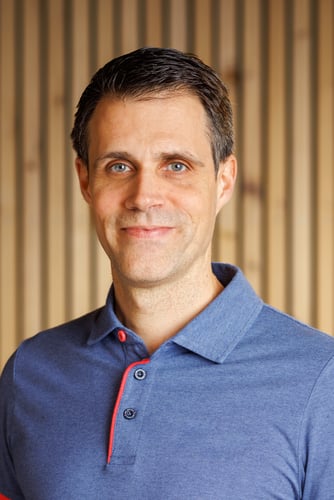 We are delighted to welcome Cédric Madelaine to machineMD as Head of Usability and Product Experience Design Lead.
 With more than two decades of experience spanning graphic design, UX, UI, and usability engineering, Cédric shares how a deep curiosity about people and their work has shaped his approach to designing medical technology.
You’ve worked across UX, UI, and usability for over two decades. What first inspired your interest in design and user experience?
What drives me most is helping people in their daily work and lives by understanding what truly matters to them, and creating solutions that make things simpler and more effective. I enjoy turning complex technology and data into experiences that feel clear, supportive, and trustworthy.
My interest in design began very early. I was always drawing, tinkering, and trying to understand how things around me worked. In my village school, we had a small program where children could visit local professionals, and I still remember watching the butcher, the hairdresser, or the railway station chief doing their work. Seeing their gestures, tools, and routines opened my eyes to how much every job shapes daily life.
That curiosity stayed with me. I’ve always loved observing how people work, how they interact with their environment, and what makes a task feel easy or difficult. Over time, this naturally grew into a passion for service and product design: designing experiences that respect the reality of the people who use them and making their day a little smoother.
I’m also energised by collaboration. Working with different experts, learning from their perspectives, and shaping ideas together is one of the most fulfilling parts of my role. I love that this field constantly teaches me something new. For me, good design is always a shared effort, and its purpose is to empower people effortlessly in their everyday lives.
How has your journey — from graphic design to leading UX and usability in medtech — shaped the way you approach product design today?
My background spans visual and interaction design, with many years of building digital products across diverse industries. It has given me a well-rounded understanding of user needs, technical constraints, and the practical realities behind product decisions.
Within medical devices, I also learned the importance of grounding everything in real-world insights. Listening to users, observing their constraints, and systematically gathering evidence provides direction and embeds a risk-based approach, which is essential for delivering safe solutions in a regulated environment.
I place great importance on helping teams connect with real users. It builds empathy, strengthens decision-making, and shapes a human-centred culture that is essential in healthcare.
When business, quality, medical, clinical, engineering, operations, and design perspectives come together early, decisions become clearer, more realistic, and far more impactful.
What attracted you to join machineMD and the neos® project?
I joined machineMD because the mission felt meaningful. I wanted to work for a company where innovation genuinely supports clinicians and patients. Seeing a young company already delivering a certified product gave me confidence in machineMD’s direction, and it’s clear that a tremendous amount of work has already been achieved together with many partners.
The mix of VR, eye-tracking, and hardware–software design with two simultaneous users was another strong attraction — a rare environment that fits naturally with my background.
What ultimately convinced me was how grounded the company’s vision felt. It struck the right balance between ambition and clarity.
How do you see your dual role — as Head of Usability and Product Experience Design Lead — contributing to the company’s mission?
As Head of Usability, my role is to ensure that neos can be used safely and effectively in the real world. It’s about clarity, confidence, and reducing the risk of errors so clinicians can focus on care rather than the device.
As Product Experience Design Lead, I look at everything around the product: context of use, workflows, tools, interactions, training, delivery, setup, reimbursement, and the overall feeling of using neos®.
When both sides work together, they create solutions that feel natural, supportive, and trustworthy. And trust is essential when introducing new technology into healthcare — especially in a field as sensitive as neurological diagnostics.
machineMD operates at the intersection of neuroscience, ophthalmology, and technology. How do you translate such complexity into intuitive user experiences?
We translate complexity into intuitive experiences by first understanding how clinicians work — their goals, routines, and constraints — even before any technology is involved. This helps bring insights into strategy and planning, ensuring decisions are balanced across business, customer, user, medical, clinical, regulatory, and operational needs.
We also work to make field insights traceable and actionable — like a treasure trove that is nurtured over time. This has to be a continuous effort.
From there, we simplify through clear models, field-driven insights, and rapid iteration. Our role as a team is to act as a bridge: turning deep scientific and technical expertise into interfaces and decisions that feel natural and easy to use.
Finally, we stay close to real use — observing neos in clinical settings and listening closely to feedback. This helps us create solutions that are usable, clinically relevant, and viable for the company.
Outside of work, what inspires your creativity or influences your design philosophy?
I’m inspired by learning — especially when it comes to new technologies and the possibilities opened by AI. They help me explore new ideas and rethink how we design and work.
I also draw inspiration from travel, particularly Japanese language and culture, which I’ve been studying and exploring for many years. Its attention to detail, simplicity, and respect for craft often influence how I think about clarity and usefulness in design.
Finally, I enjoy restoring and experimenting with retro technology and old electronics, such as video games and synthesizers. Working with these objects reminds me that thoughtful constraints and well-crafted simplicity can be just as innovative as the newest tools — a perspective that strongly shapes my design philosophy.