machineMD at AAN 2026

18 April - 22 April, Chicago

Presentations, posters, and live demonstrations of neos®

avantika naidu web

Dr.
Avantika Naidu
VP Business Development

62b1900ffd94c5804f75e495_Dr. Pia Massatsch

Dr.
Pia Massatsch
Head of Clinical Affairs

Sunday April 19th, 8:00 AM - 9:00 AM - Poster Session 1
Movement Disorders: Parkinson's Disease Genetics, Biomarkers, and Basic Science 

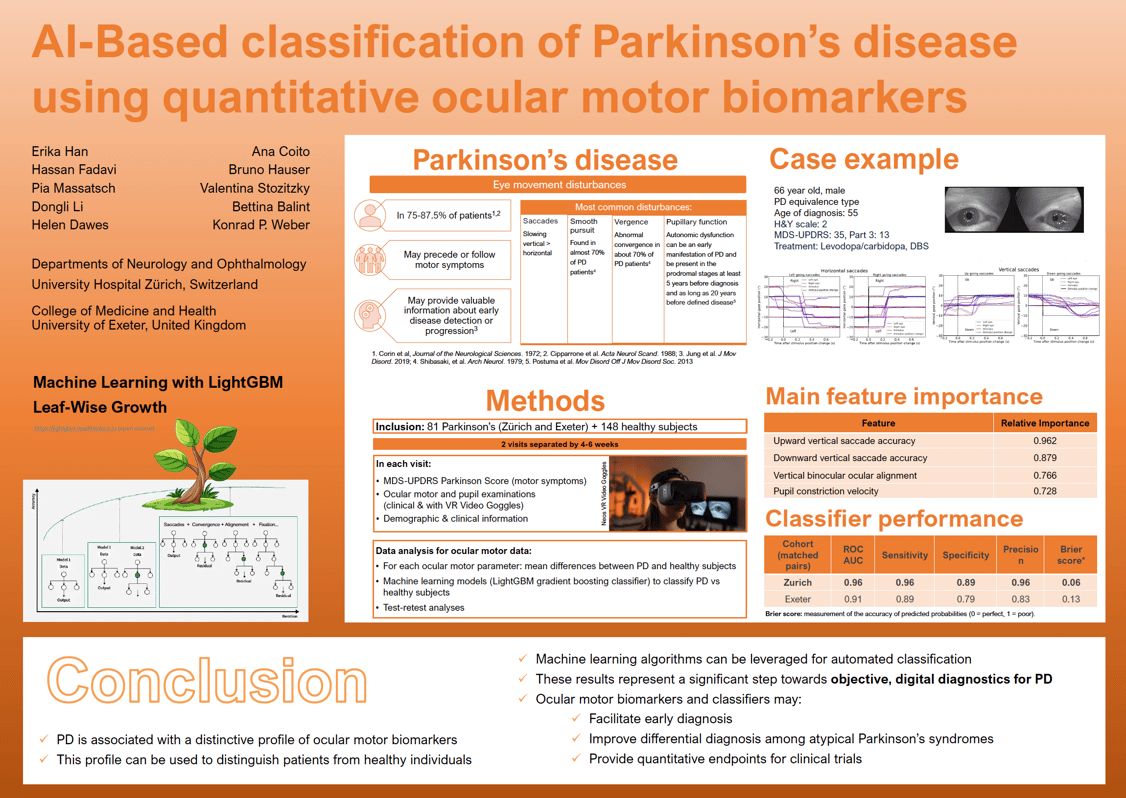
AI-Based classification of Parkinson's disease using quantitative ocular motor biomarkers

Screenshot 2026-03-20 at 17.14.02

Wednesday April 22nd, 8:00 AM - 9:00 AM - Poster Session 10
Manisha Kotay, MD, Eric Eggenberger, DO
Mayo Clinic Florida

Reality Check: Virtual Tools in Functional Vision Disorders

Objective:
Describe the utility of virtual perimetry in workup  of patients with functional visual loss (FVL) .

Background:
Functional vision loss can be difficult to prove especially when deficits are seen on automated perimetry. Virtual reality (VR) perimetry has emerged as a promising tool for assessing visual function in individuals with FVL.

Design/Methods:
Retrospective review of 5 patients ages 19-60 years presenting with visual defects on automated perimetry due to functional visual loss.  The patients presented with varied visual symptoms including abnormal automated perimetry in contrast to intact confrontational perimetry and normal structural exam. Virtual [gaze-dependent] perimetry (neos, machineMD) was performed and compared to automated perimetry.

Results:
While standard automated perimetry revealed  varied defects,  VR perimetry documented largely normal visual fields. 2 patients had monocular deficits on perimetry and normal virtual perimetry; 2 patients with monocular deficit on automated perimetry showed a homonymous pattern on virtual;1 patients with right homonymous defects on automated perimetry had normal virtual perimetry.

Conclusions:
VR-based perimetry provides a novel tool for assessing visual function  and may be a valuable adjunct in evaluating patients with suspected functional visual loss. The usefulness of virtual perimetry in functional patients may be related to a binocular paradigm with monocular data acquisition.

Wednesday April 22nd, 11:45 AM - 12:45 PM - Poster Session 11
Jeffrey Gluckstein, MD
Keck Medicine of the University of Southern California

Preliminary Validation of the neos® Sensorimotor Exam in Clinical Practice

Objective
To evaluate the diagnostic performance of the neos® device as an automated tool for sensorimotor assessment.

Background
Sensorimotor examination is a cornerstone of diplopia evaluation but requires specialized training. Many neurologists encounter patients with diplopia or ocular misalignment but lack the tools or expertise for sensorimotor assessment.
The neos® device (machineMD, Bern, Switzerland) automates components of the sensorimotor exam, offering the potential to extend diagnostic capabilities to non-specialists and enable remote evaluation.

Design/Methods
Patients presenting to the neuro-ophthalmology clinic with diplopia or related complaints between September and December 2024, along with consenting controls, underwent testing with neos®. Results from the neos® sensorimotor exam were compared with conventional alternate cover testing in primary gaze. Diagnostic accuracy was assessed by comparing the full clinical diagnosis from in-person evaluation with the diagnosis of a blinded neuro-ophthalmologist who reviewed only neos® data and a one-sentence vignette, simulating remote consultation.

Results
Thirty-five participants were enrolled (mean age 55.0 = 18.5 years; 40% male). Abnormal sensorimotor findings explaining diplopia were identified in 18 (51.4%) by standard exam and in 23 (65.7%) by neos®. The sensitivity and specificity of neos® for detecting sensorimotor abnormality were 88.9% and 58.8%, respectively. neos® measurements of deviation were within 5 prism diopters or 25% (whichever was larger) in 60.6% of horizontal and 75.8% of vertical cases.
In a simulated telemedicine context, neos® data enabled accurate diagnosis in 21 (60.0%) cases. It measured a vertical deviation greater than 1 prism diopter in 15 (65%) of cases with no vertical deviation on clinical exam.

Conclusions
The neos® device provides a promising means to obtain sensorimotor exam information, but may provide artifactual data or false vertical deviations. With refinement in measurement precision and clinician experience in data interpretation, neos® could facilitate broader access to accurate strabismus assessment.

View the full scientific program here

neos_r_Logo_neg

neos checkbinocular quantitative pupillometry

neos checkocular alignment

neos checkfusional amplitudes

neos checksaccades

neos checksmooth pursuit

neos checkgaze holding

neos checkvisual field


clock_icon Standardized    brain_mixorangeblack_icon Objective    data_icon Quantitative

Let's keep in touch!

Please share your details with the machineMD team via the form below to learn more about clinical and research possibilities with neos®